The Shift That Changed How I Use Claude For Marketing
Mohammed Ikram Nagdawala2026-05-05T08:33:52-05:00Intro
Out of the campaigns I ran in the last six months, there were two that taught me the same lesson from different angles.
The first was a paid search campaign where I trusted the platform defaults under my own setup. By week two, the platform had automatically adjusted some elements of my setup, rendering the initial performance data unreliable. The second campaign I’m referring to was a paid social campaign where I neglected to verify the baseline level of organic content underneath my proposed paid effort. As the campaign went, the lack of organic content became apparent within the first month – it simply did not provide enough depth to support paid.
The lesson here is universal – I had reviewed the campaign plans, but did not review the layer below them. Both flaws would have been uncovered during our brief review if I questioned the briefs the way leadership usually does in other meetings.
After the second campaign, I stopped trying to remember to ask the right questions in my head and started building something that would help me to. That thing became the pre-launch audit, and it has shifted how I use Claude more than any productivity trick that I discovered in a year before that.
Two ways to use Claude, and only one of them creates leverage
The vast majority of marketers I know uses Claude as a writing tool. They open a chat, paste in a brief, ask for ad copy or a landing page or an email sequence, get a response that is good enough to edit, and send it off. The process is streamlined. It makes marketing teams feel productive. And the efficiency gains are clear enough that most of us ignore the other option.
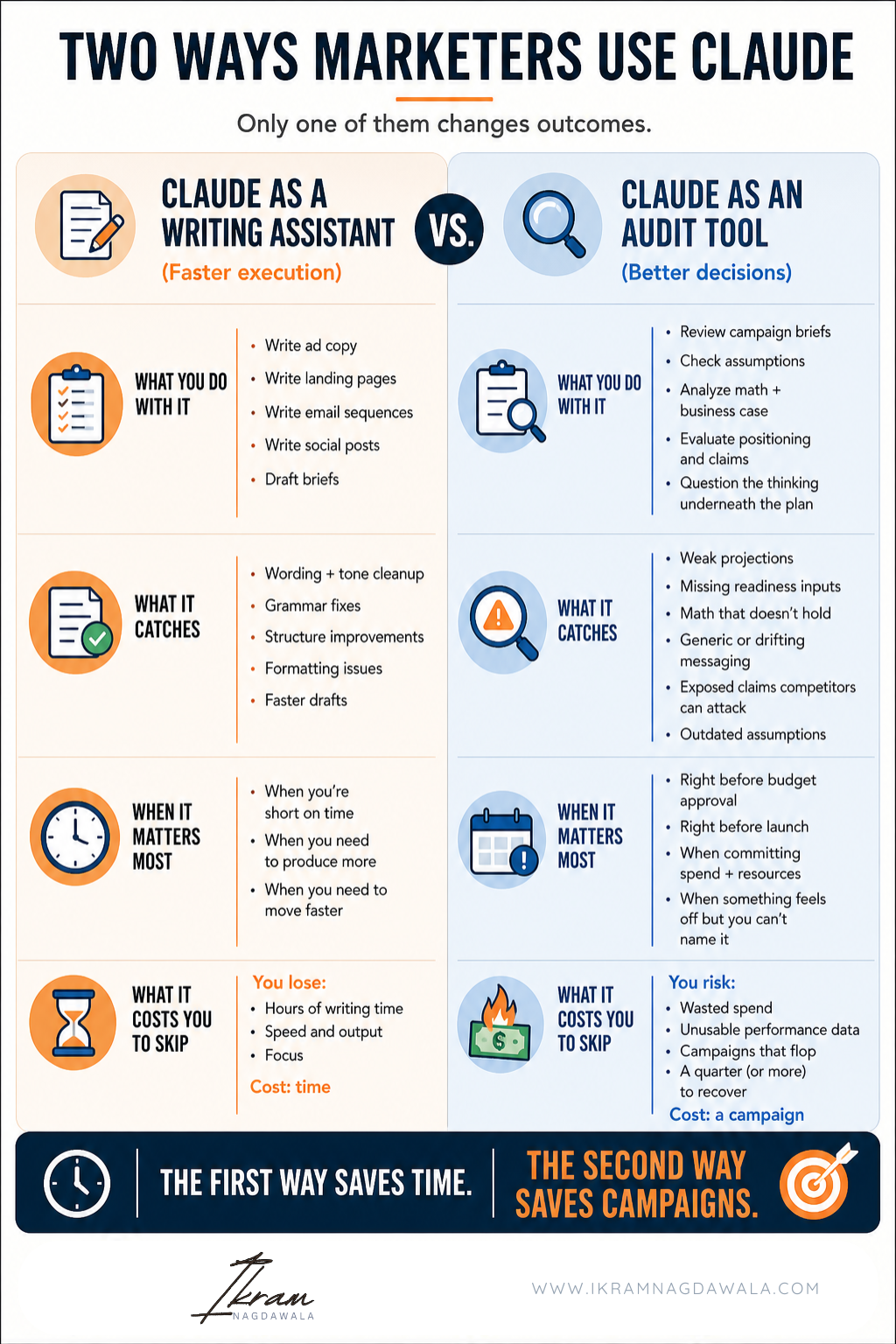
There are two ways to use Claude as a marketer, and only one of them compounds.
The first way is to use Claude as an alternative to manual drafting. Ad copy, social content, email sequences – it is faster. The output is clean. Productivity wins are tangible enough that it is hard to recognize the shift you’re not making.
The second way is using Claude to review the thinking behind the campaign you’re about to launch. To question your core assumptions, find flaws, and surface risks. This kind of usage does not make your work faster. But it prevents failed campaigns. And the difference between those two options is bigger than most productivity tutorials make it sound.
What the second way actually looks like
Step 1: Readiness check
Before any analysis, the audit checks the brief for five crucial components. A clearly articulated and timed outcome. Math supporting it. Draft messaging that is actually copy written. Claims that you will be making. A clearly articulated rationale for launching now. If any of those components is missing, the audit will flag them and will ask whether to proceed or pause to develop what’s missing. The vast majority of briefs I’ve run through the audit lacked one of those components. Sometimes two. The brief seemed complete, but then the audit revealed what I’d glossed over.
Step 2: Business case and financial implications
This step often catches the weakest campaigns. The audit runs the projected numbers through a finance lens. What is the underlying assumption of the business case here? Do we have evidence for it being currently true? The audit surfaces the numbers cited as known when, in reality, it has been pulled from a previous campaign and does not fit. The cost-per-lead benchmark borrowed from the warm webinar audience, applied to cold outreach? This step will identify it.
Step 3: How the buyer perceives it
Claude will run the brief through the filter of your most current persona. What language will they perceive as generic and skip? What wording makes them think we sound like every other vendor in their inbox? Which sentence from the drafted messages will actually make them pause and look at it? This step will identify all gaps in the messaging with exact wording you are using. It is the most uncomfortable of the five, but it tells you whether you have a shot.
Step 4: What the competition sees in it
Using the competitive map from your context files, the audit will test your messaging from the position of the leading competitor. What claim would the competitor target as the weakest one? How would they counter it? What evidence would they present to support the counter-claim? What remains unaddressed for the buyer to consider? The goal is not to predict what your competitors will do. It is to check whether your claims hold up under scrutiny.
Step 5: The assumption upon which everything relies
In this final step, the audit identifies the biggest assumption of the campaign. The foundational belief about the buyer and the market, on top of which the rest of the brief is built. Then, it will check for the evidence proving the assumption. Why? Because many campaigns fail because their assumptions are outdated.
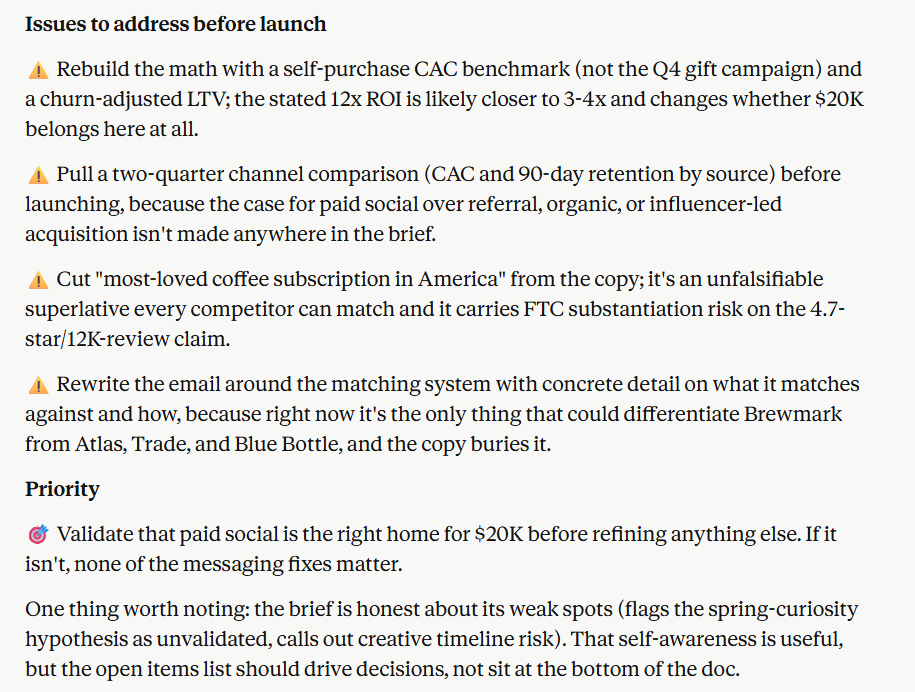
This entire process takes about 30 minutes. The output of the audit is a list of actionable insights with the most critical issue called out separately.
What this changed in practice
Each of the two campaigns that I talked about earlier would have been caught by this audit if it had existed.
The paid search campaign that had failed due to the platform overriding the setup would have been flagged at step 5 of the audit. Why? The brief assumed the platform will respect my setup. When you need to articulate the evidence behind the assumption, you look into it before launch.
The paid social campaign without organic reach underneath would have been caught at step 2, where we check the math and the business case behind it. The projected outcome relied on the assumption that the organic will compound on the paid. What is the biggest assumption of this project? How do we prove it? A quick glance at the organic baseline before launch would confirm that there was no organic baseline.
Both of those campaigns cost real budget to learn from. Running the audit would cost me 30 minutes. That is the trade I now run.
Why I built it as a Claude skill
First, I tended to forget steps when rushing or working late. Which was precisely the moment where I needed to run an audit.
Second, the prompts would drift. I refined one of them on the fly, lost track of the change and ran the drifted prompt next time. Not good for comparing campaigns over time.
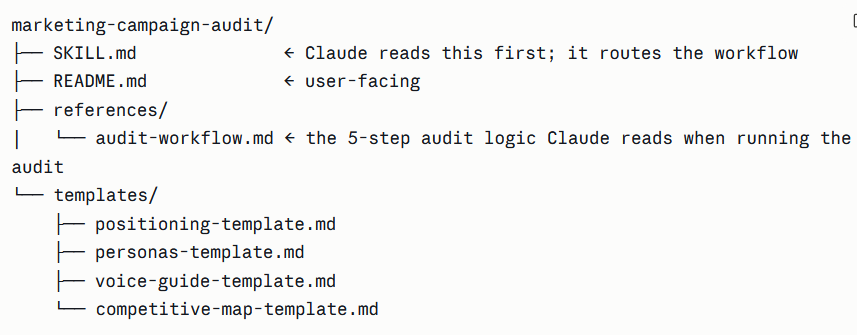
For this reason, I decided to package it as a Claude skill – a script of prompts Claude will execute in order once I instruct it to. Install the skill, type “audit this campaign” with your brief attached to the chat, and wait for Claude to start asking you questions. One step at a time. Same audit every time.
I made it freely available for anyone to download. Complete with four templates to set up the strategic context I mentioned above (positioning, ICP, personas, voice guide, and competitive map). The skill itself is available to download at the end of this post.
Where the leverage actually is
The audit is useful, but it is not the point of this article. The point is the shift underneath it.
Most of the value I get from Claude now comes from pointing it at questions that would not otherwise get answered. Not because the team is lazy. But because there is simply never enough time to rigorously question every assumption behind every campaign, every quarter, against current market conditions. They slip through the cracks and are built into our briefs. Which means campaigns are launched based on outdated assumptions.
A team using Claude as a writing assistant cannot fix this. Because the questions do not show up in the writing workflow. They show up upstream, in the strategy and the brief and the assumptions behind the targeting. A drafting tool will only enable you to create copy fast on assumptions that may or may not be valid.
A marketer using Claude to question their own thinking can answer the upstream questions in 30-45 minutes. Not perfectly, of course, chances are Claude will sometimes miss the point. But asking the question and getting a 70% answer beats not asking the question at all. Most strategic questions in marketing do not need a perfect answer. They need a good-enough answer surfaced early enough to act on.
If you have been using Claude mostly to write things faster, the productivity gains are real but limited. You will get back hours per week. That is worth having. But the larger unlock sits one floor up from the writing layer, and most of us do not get there because the writing wins arrive first and feel like enough.
I would rather catch a bad campaign 30 minutes before launch than three weeks after. That is the shift. The Claude Skill is one way to make it. There are others. The shift is what matters.
The full Claude skill, including the audit workflow and the four context templates can be downloaded by clicking the button below.
If this audit skill catches something useful for you, I would like to hear what it caught. Comment below or message me.

Comment (1)
[…] is the second free tool I’ve published this year, after the marketing pre-launch campaign audit skill. And it is deliberate. Building something useful and giving it away teaches me more than sitting on […]